
We live in extraordinary times to have access to untold information about our ancestors online.
As we gather facts, it is always important to double and triple-check reference sources.
One of the most essential tools in researching family history is the surveying of the surrounding neighbors and associates of our ancestors.
The F.A.N. Method, as detailed by Elizabeth Shown Mills, C.G., explains how looking more closely at those names can yield absolute results.
Several years ago, I applied the F.A.N. Method to search for my 4th great-grandmother, Emeline, and her family in the 1870 U.S. Census.
A good tip for Black people looking for ancestral clues in the 1870 census is to check the three pages before and after the census page where your ancestor is listed. Why? There may be possible relatives within those pages. With this in mind, Ancestry has a tip page entitled Browsing U.S. Censuses by Neighborhood.
The 1870 U.S. Census shows my ancestor, Emeline, living with her husband, Benjamin Eppes, and five children (including my 3rd great-grandmother, Josephine).
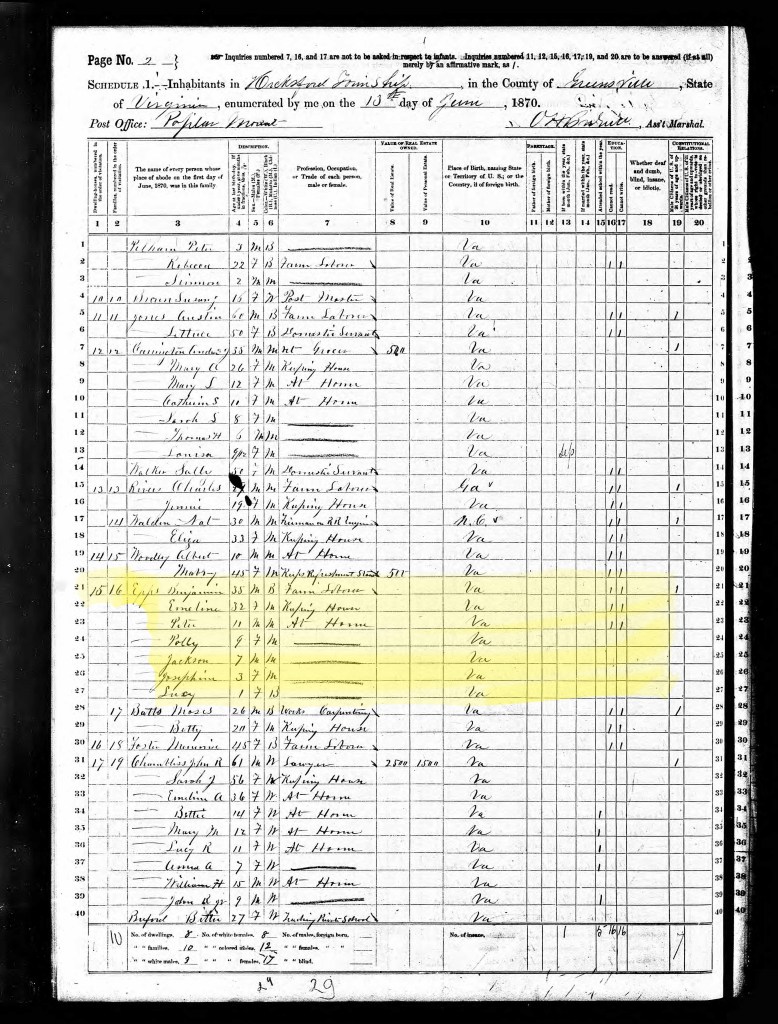
Looking at the top of the census page No. 2, we can see that members of the Pelham family are enumerated. At the bottom of the page, 27-year-old Bettie Buford, a private school teacher, was counted.
As I pored over this document on Ancestry, I decided to view the previous page to find out what more I could learn. This was an easy decision because, on Ancestry’s website, the image showing Emeline’s family is on page 72 of 72 for this record set.
Page 71 of the 72-page set for this section of the U.S. Census record is the end of the enumeration for the Belfield district. It concludes with family No. 581. Remember, if you will, that Emeline and her family were family No. 16. Also, the actual census page for Emeline and her family was page 2. This is page 71.

So, for accuracy’s sake, Emeline and her family should be on census page 2. So, just who is on page 1 of this census record?
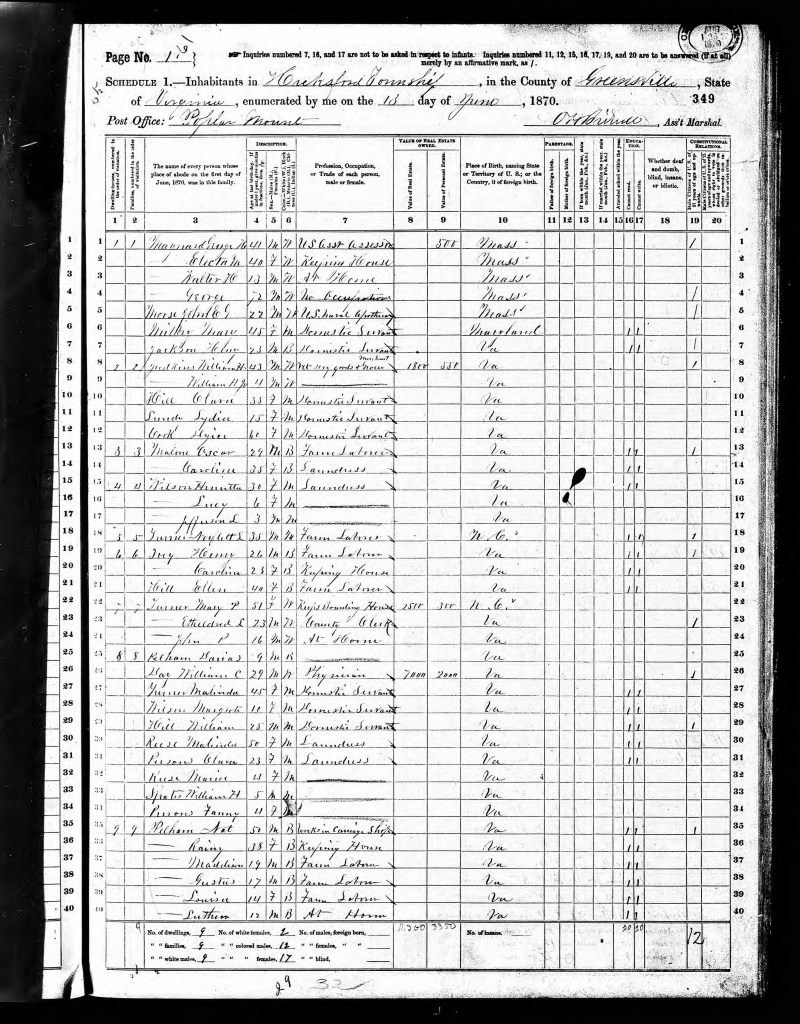
The above are Emeline’s actual neighbors. What is the significance of finding the correct neighbors in a census record? As mentioned before, they very well could be family.
As I look at page 1, I immediately spot an exciting find.

Household No. 8 is a literal motley crew of characters. For whatever reason, nine-year-old Darius Pelham’s name is listed first. Surely, he wasn’t the head of household. Next, Dr. William C. (Chilton) Day is enumerated. Dr. Day was a Confederate surgeon, in 1870, he was practicing medicine in Hicksford, Greensville County, Virginia. There are three other children listed, though one 10 year old, Margaret Wilson, is listed as a servant. Another child’s name, 5 year old William H. Spates, is a major clue about who these occupants really are.
In my State of Spates blog post, we reviewed the story of Irvinia and William H. Spates Sr, whose harrowing attempt to escape the ties of slavery were documented in several newspaper reports.
Irvinia was a daughter of our own Clara Mabry.
Clara had other children, including Clara Jr and Malinda. I believe that Clara’s family is in this very household. Further, I think Clara Mabry is a close relative of Emeline’s.
The Dr. Day household and Emeline’s family are in very close proximity. This is a fact that I would not have known if I had not correctly organized the census pages.
As such, this is an excellent reason to make sure that the order of the census pages is correct in whatever database you are using to view them.
What did I do to correct this error in the larger sense? I reached out to Ancestry via their reporting tool, and I posted comments on the census pages and Emeline’s profile page.
Unfortunately, there has been zero change or response as of today. I made that report about the error in 2017.
What about other websites? FamilySearch and other websites have census records readily available, too.
On another note, the 1870 census is not yet available online via the U.S. National Archives website.
Isolated incident or not, the takeaway is that you must closely inspect all of your sources, no matter how seemingly authoritative they are. Double-check and cross-reference your data to ensure you have the most accurate facts possible.
That is how we break through genealogical walls. We have to clean up the aisles…
This is our situation.
The Genealogy Situation Room
——Thank you for stopping by and thank you for your supporting the blog!
Donations kindly appreciated at:
PayPal @BarbieJ
CashApp $TGSRoom
 The Genealogy Situation Room