
In 1856, there were several news articles discussing the attempted escape of enslaved Irvinia, daughter of Clara Mabry. Irvinia had been added (by her mother) as security for debts owed to several “benevolent gentlemen” in Hicksford, Greensville County, Virginia.
Even though Irvinia was married to Timothy Spates, a free man of color—also in Greensville County, Virginia, she was held enslaved by Capt. John W. Potts.
Timothy and Irvinia plotted and dared to escape her bondage by having Irvinia portray herself as a white woman traveling with her male servant, who happened to be Timothy. Along the way, Irvinia was found out. According to the news reports, Irvinia declared that she was free to go where she pleased and that a certain Dr. Johnston or Johnson of Portsmouth, Virginia, could attest to that fact.
Here the doctor is referred to as Dr. Johnson:
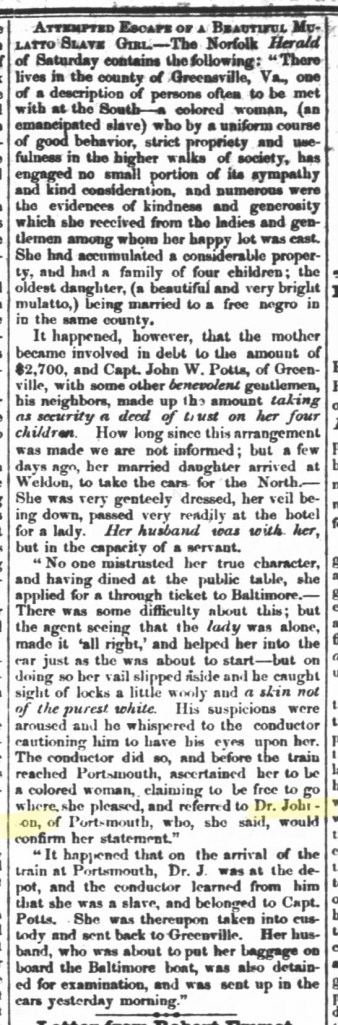
Belvidere, Illinois
14 Oct 1856, Tue • Page 1

Raleigh, North Carolina • Wed, Aug 20, 1856 Page 4
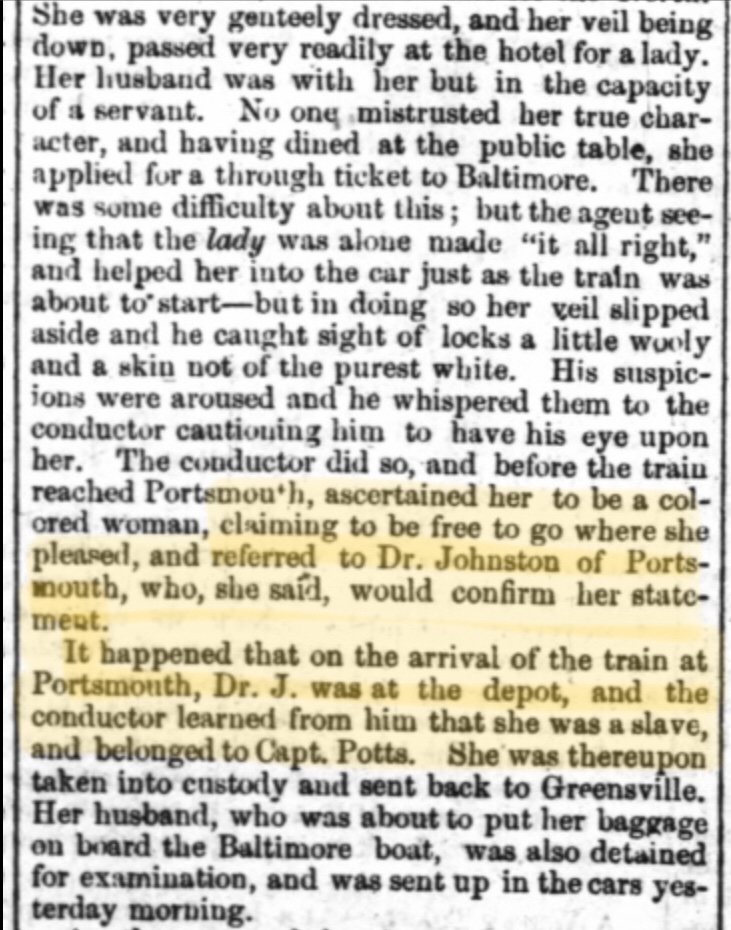
…claiming to be free to go where she pleased, and referred to Dr. Johnston of Portsmouth, who she said, would confirm her statement.
It happened that on the arrival of the train at Portsmouth, Dr. J. was at the depot, and the conductor learned from him that she was a slave, and belonged to Capt. Potts…
Turns out that Dr. Johnston was indeed at the rail station in Portsmouth upon the arrival of Irvinia and Timothy; however, Dr. J. declared Irvinia to be a slave of Capt. JW Potts and she was duly apprehended and taken away. Timothy, who was loading their bags for the next leg of their journey was also apprehended.
Ever since I have come across this fascinating story, I have wondered just who is this mysterious Dr. Johnston. It seems mighty convenient that he happens to be at the train station just as Irvinia expects. Why would he betray her? Surely, she would never have brought him up if she thought that he would turn her in.
If we look at the places mentioned in the articles about the incident, we see that Weldon, North Carolina along with Portsmouth, Virginia, and Baltimore Maryland were mentioned as the route/attempted route taken by Irvinia and Timothy.
These locations are well-known stops on the Underground Railroad, according to various sources.
I have asked myself whether this doctor could have been a conductor on the Underground Railroad, waiting for his passengers to arrive that day in Portsmouth, to carry them to safer places. The question rings, why did he betray them? Did he not expect Timothy to be with Irvinia? Were they lured there under false pretenses? Was Dr. Johnston spooked by the discovery of Irvinia? Is it possible that in his haste to protect any covert operations, Dr. J did a 180?
So many questions and the first one is…just who is this Dr. Johnston?
The other day, for some inexplicable reason, I kept thinking about the name—Doctor Johnson of Portsmouth—-Doctor Johnson of Portsmouth. After reading my Bible and giving the Lord the first fruits of my day, I searched for the possibility of discovering information on one Doctor Johnson versus Doctor Johnston.
Within five minutes, I discovered this document on FamilySearch:

DearSir
You will please issue to Dr. Johnson a license to unite in the bonds of matrimony
Respectfully
James A. Rivers
E.A. Lafferty
Greensville County
10 June 1851
License issued 10 June 1851 J. T. cc
So we have here a certain Dr. Johnson who is writing to the Court of Greensville County, Virginia in 1851. This is five years before the incident with Irvinia and Timothy and gives me pause to think that we are getting closer to solving this mystery.
The “benevolent gentlemen” and Clara Mabry were all on the Greensville County, Virginia scene in the early 1850’s.
What other clues can be found to learn more?
Knowing the place, time, and names that I would like more information on, I decided to check the Library of Virginia’s Chancery Records.
The 1854 Greensville County case of James Johnson v. Junious D. MacLin, a contract dispute, immediately caught my attention. There on page 34 was confirmation that James Johnson was Doctor James Johnson…
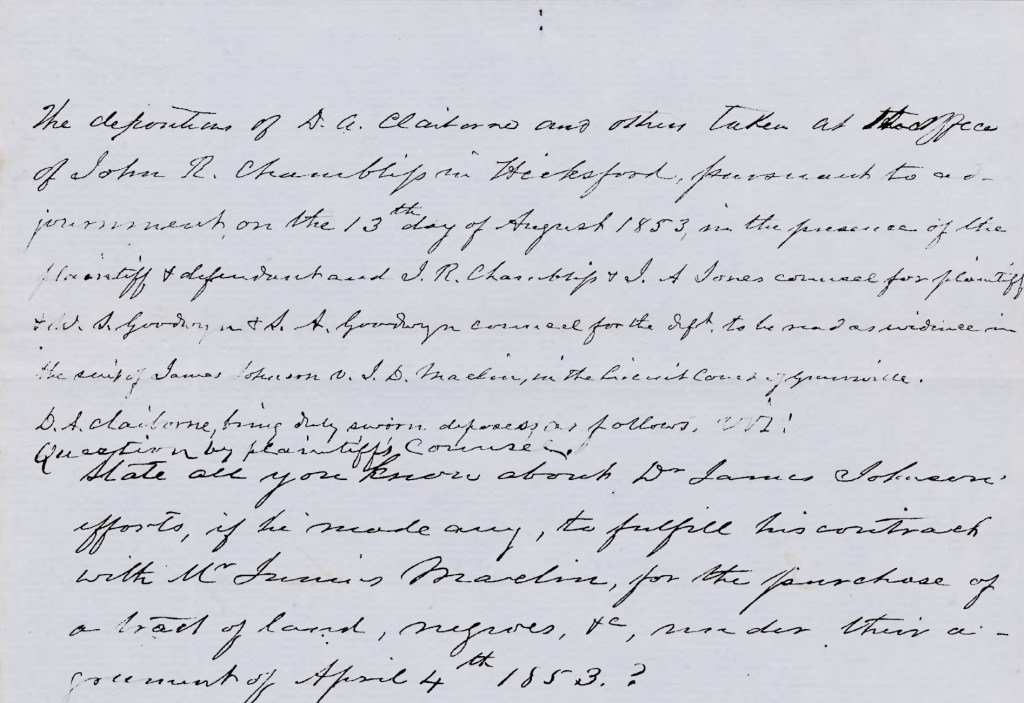
The depositions of D.A. Claiborne and others taken at the office of John R. Chambliss in Hicksford, pursuant to adjournment on the 13th day of August 1853 in the presence of the plaintiff + defendant and J.R. Chambliss + J.A. Jones counsel for plaintiff + W.A. Goodwyn + S.A. Goodwyn counsel for the Deft. to be made as evidence in the suit of James Johnson v. J.D. Maclin, in the Circuit Court of Greensville.
D.A. Claiborne being duly sworn deposes as follows, viz:
Question by plaintiff counsel
State all you know about Dr. James Johnson’s efforts, if he made any, to fulfill his contract with Mr. Junious Maclin for the purchase of a tract of land, negroes, etc, under their agreement of April 4th 1853?
James Johnson v. Junious D. MacLin, 1854 Greensville County, Virginia Chancery Case
Wow. So here is a Doctor Johnson who is in the same whirl and rash as at least one of the so-called benevolent gentlemen, John R. Chambliss. Looking further, the court documents that Doctor Johnson was a business associate of Dr. A.T.B. Merritt, a prominent doctor and businessman, and in 1850, the seller of property to our very own Clara Mabry, Irvinia’s mother. Just by these connections alone, there is strong circumstantial evidence that this could be our Dr. J. of 1856.
Still, according to our primary news source, it states that Dr. J. was from Portsmouth, Virginia. Johnson versus Johnston is debatable but does our Doctor James Johnson have ties to Portsmouth?
Enter the 1859 City of Portsmouth chancery case of M.T. Peete v. A.T.B. Merritt ETC. On page 29, we see that Doctor James Johnson is in partnership with a certain D.A. Walton in the timber business and they are in league with A.T.B. Merritt.
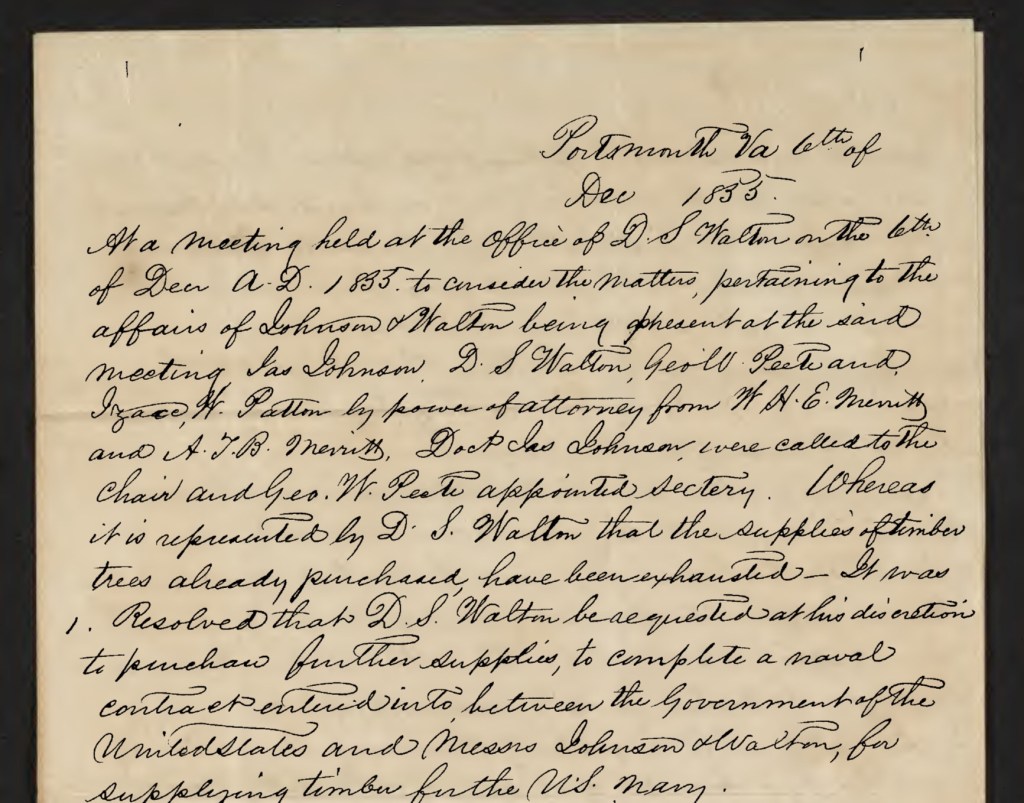

In the winter of 1855-56, I was requested by Dr. A.T.B. Merritt to go down to Portsmouth Va with a power of attorney for and in behalf of himself and his brother WHE Merritt to represent them in closing up for that year, and in making arrangements for conducting-during the next year 1856 the business of two firms “Johnson + Walton” and the “Nottoway Lumbering Company”-of which firms they were members. Mr. Walton was the agent for transacting the business of “Johnson + Walton” and Dr. Peete was the agent for the “Nottoway Lumbering Company”—about the 6 oclock? —a meeting was held that the agents might give an account of the affairs in the past year and to make arrangements for conducting them in the ensuing year…
On assembling Dr. Johnson was called to the chair and Dr. Peete was chosen secretary…
1859 City of Portsmouth Chancery Case MT Peete v. ATB Merrit ETC—page 33
My friends, all things considered, I do believe that Dr. James Johnson is the Dr. J. (Johnston) of our 1856 saga. He knew all of the players involved, based on court and primary source (news article) evidence and he would have been conducting business in Portsmouth in the summer of 1856.,
Given what has been shown about Dr. Johnson and his business dealings, I am not inclined to believe that he held any interest in helping anyone escape from the bonds of slavery. Still, there is intrigue.
WOW.
We’ll just have to save that mystery for another day.
The Genealogy Situation Room
 The Genealogy Situation Room